
The Heartless Apathy Embedded Within “AI”
A reminder that learning is only possible through the embodied and passionate work of the head and the heart. Human beings do not live on words alone.

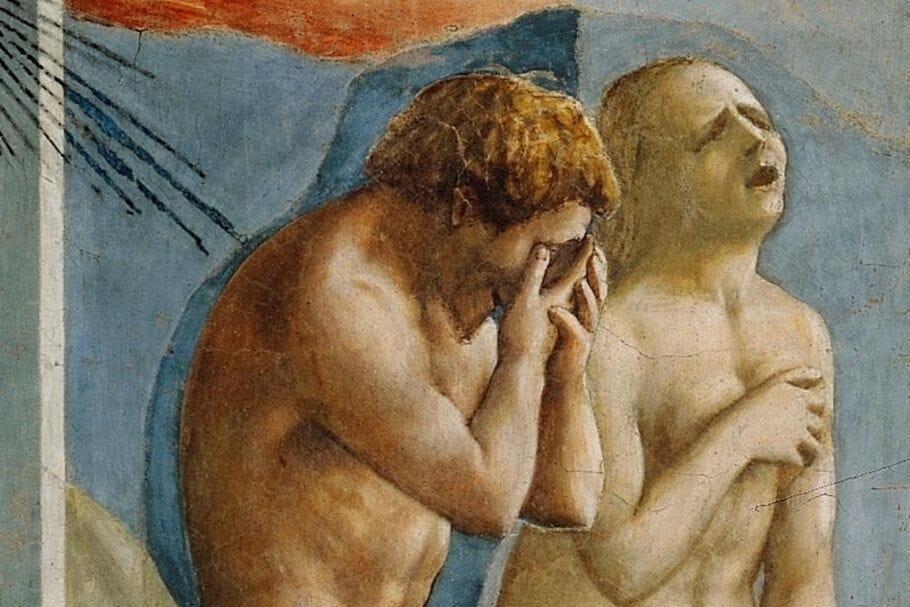
[Masaccio, “The Expulsion From the Garden of Eden,” 1425. Adam and Eve in this painting clearly suffer for their choice to give in to the serpent’s temptation. Is their passion in this painting something to flee or embrace?]
Recently a student disclosed to me that they were taking a break from using ChatGPT as a tool to check their homework while working to complete it.[1] This student found that their problem-solving skills had diminished by relying on ChatGPT and prudently turned away from it. For the student’s sake, I hope there is no return to the habits that diminished the capabilities they built up without the aid of ChatGPT. I wonder how many students have similar realizations. I also fear to find out how many students don’t see that their reliance on ChatGPT and other similar “AI” models diminishes their capacity to do intellectual work.
The student noted that they were initially drawn to the confidence ChatGPT showed in its answers. This confidence, however, became more alarming when ChatGPT was wrong. The student was somewhat astounded that ChatGPT could confidently state a wrong answer and then, once the student spotted the error and prompted the program with a statement about this mistake, see it confidently state, “You are so right. That is wrong.” The student was further taken aback by the realization that ChatGPT will not correct its errors unless it is prompted to do so. The student was angry that ChatGPT is an effective, unrepentant liar.
I have written elsewhere that “AI” has no place in liberal education. If I were to revise that argument, I would say that “AI” has no place in education at all. The heart of my argument is that “AI” permits an artificial separation of the capacity for speech and reason from the human person. Because the human capacity for speech and reason is naturally inseparable from the human body, there is something necessarily embodied about that capacity’s exercise. This is a truth about our nature that we must not only acknowledge and respect, but love.
Thinking of what the truth of this embodiment means for learning, I asked my student, “What do you feel physically when you realize that you’re wrong about something?” The student said they feel some sort of tightness and emptiness in the chest. I said, “So you feel it in your heart?” The student said, “Yes.” I then noted to the student that this bodily reaction is a real-time corrective to falsehood. When we experience this sensation, we instantly have a choice: respond to that sensation and correct our mistake, or ignore that sensation and persist in our error. ChatGPT, by contrast, has no sensations and cannot have any sensations. Further, it has no choice; it is simply determined by its coding.
I next asked my student, “What do you feel physically when you discover that you’re right about something?” The student responded that they feel something like an opening and filling up in the chest, and we both agreed that this too was a work of the heart. Again, ChatGPT has no sense and cannot have any sense of when its deterministic coding renders language in such a way that it presents something true. Only human beings are capable of sensing truth and falsehood. Our capacity for sense-perception exists together with our capacity for speech and reason. We are the only creatures who are capable of living with a naturally embodied sense of what is true and false. Upon sensing truth and falsehood, we have the opportunity to choose the one with which we will live in accord. And whether we live according to the truth or turn away from it, our hearts will feel it and we will know the nature of that choice.
My conversation with this student helped me find a better way to articulate the deep apathy that exists by necessity in “Large Language Model” (LLM) forms of “AI.” According to its Greek roots, “apathy” means “without (a-) passion (pathos).” Because LLMs are disembodied, they have no passions. LLMs present only words. In this respect, LLMs rely on only one part of all the things the Greeks captured with the term logos. In addition to “word,” logos can mean “speech,” “reason,” “argument,” or “the rational account” of something. The Greeks understood that while there might be tensions between logos and pathos in human beings, the two are naturally bound together. We form our character (ēthos) in the dialogue between logos and pathos, a dialogue that is naturally set into motion by sensing what is true and what is false. Who we are, our character, is something we come to know if we have the courage to look at what is in our own hearts and, in some mysterious way, touch who we are.
Our world in which LLMs and “AI” have taken hold of people’s minds and hearts rests on a lie that I have argued we can trace back to Thomas Hobbes. In both Elements of Law and Leviathan, Hobbes reduces reason to its mathematical form based on the premise that it needs to be free from the influence of human passions because these naturally drive us into war. All computing reduces to mathematical binary coding. While the human beings who produced this coding are undeniably exceptional in their mathematical abilities, mathematical calculation is only one small subset of what human logos encompasses. If one needs tangible proof of what damage can be wrought by leaving so much of what influences our lives to the technology produced by these mathematical figures who thrive in Silicon Valley, look no further than all the inhuman consequences of their technology in the past two decades. These figures could not see the effects of their technology on human beings because their primary and limited mode of thinking is not on human terms.
Human life will not be better if we become more dispassionate. It will be entirely “apathetic” in the most literal sense of the term (that is, it will be “without pathos”). We have been wrong to think that a more reasonable world is a less passionate one. Such a world would be one without love. Our logos and pathos both come to life, even sing, when they are in touch with our capacity to sense and love what is true. Cliché as it may sound, we can live fuller lives if we pay closer attention to when our hearts are fully into something. Next time you encounter something true, take notice of how your heart responds to it and the choice that you must promptly make. There is more life in that moment than anything you could possibly do with “AI.” Trust your natural senses and intelligence, and don’t be afraid to live with wonder in and through those capacities. To your great surprise, you may find something to love.
[1] I know the use of “they” in the preceding sentence and throughout this post is grammatically incorrect. I do this solely to preserve my student’s anonymity.